Sunday, 8 April 2012

Money

Sun 8 Apr 2012 23:51 - UK Markets are closed

We don't need the banks: Why Zopa, RateSetter

As peer-to-peer lenders get the thumbs up from the Government, Robert Powell visits a recording studio that has benefitted from this new form of finance and if we still need banks…
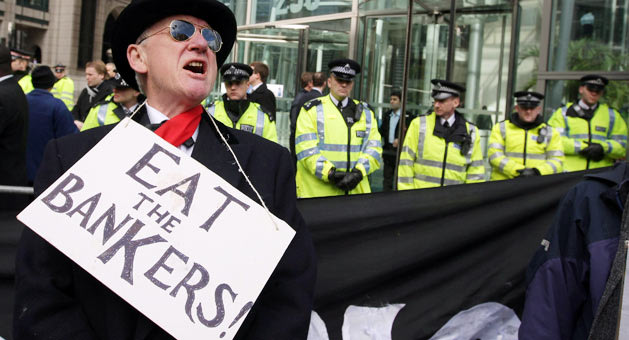
Bankers - we don't need them any more (Image © PA)

“One of the best pianos for jazz music in Europe,” is how Mark Thompson lovingly begins describing the contents of his North London recording studio. Housed on a quiet residential street in Haringey, Snap Studios has built its reputation on its use of vintage gear. But the financing method used by the business is anything but retro.

Around eight months ago, Thompson took out a loan through the peer-to-peer lender Funding Circle, to help grow the business overseas. An experienced businessman, he had always been loyal to one major high street bank – even forging a friendship with his bank manager, Ian. But now Ian had retired, and disillusionment with the modern, faceless world of banking led Thompson to try a new form of borrowing.

“I like the concept of feeling that human beings were investing in the business… It’s sharing the adventure with all and sundry, rather than just dealing with a faceless computer,” he said.


Human touch lending

Funding Circle works by putting savers in touch with businesses who need a loan – credit checking the borrower fully along the way. It is one of a handful of new online money marketplaces bringing something of a human touch back to banking. Since its inception in August 2010, Funding Circle has financed over 650 loans worth more than £28 million to businesses.

James Meekings, co-founder and director of the lending site, said: “You get to support small businesses and really see what your money is doing. I think that gives a different appeal to the service that you can get through any other financial product.”

And the returns available to the saver aren’t bad either. Funding Circle currently offers a gross yield of 8.3%, minus 1% for fees. However lenders do have to factor in the risk of borrowers being unable to repay their loan.

The lending portal only allows established and creditworthy businesses to borrow. The companies that are accepted are also graded from A+, indicating a very low risk, to C, indicating an average risk. The estimated bad debt across these bands ranges from 0.6% for top ranked companies to 3.3% for the medium ranked ones. This allows lenders to manage the risk they take on.

Investors are also encouraged to ask questions and probe the businesses. This can serve to reaffirm their financial credibility and establish their business morals.


The future: regulation?

But Funding Circle isn’t the biggest fish in the peer-to-peer pond. That title goes to Zopa: an online marketplace that has arranged over £190 million of loans between individual members since 2005. Like Funding Circle, the site credit checks all borrowers and grades them according to risk.

Zopa’s chief executive Giles Andrews is also chair of the Peer-to-Peer Finance Association, a self-regulatory trade body comprising of his own business, Funding Circle and RateSetter.com. The association was set up to ensure high minimum standards across the industry and to lobby the political interests of the sector – one of which is to gain endorsement from, and eventually appropriate regulation by, the Government.

“Our businesses are all about building trust we’ve all been working hard to be as transparent as we can and doing what we can to promote trust. But obviously regulation would be a considerable help in that regard,” says Mr Andrews.

But so far all the peer-to-peer industry has got from the Government is an endorsement of their rules and codes of practice by the Department for Business, Innovation and Skills.

For Rhydian Lewis, chief executive of the peer-to-peer lender RateSetter.com, part of the explanation for this reticence on the part of the Government is the current fragile and rapidly changing financial climate.

But he also pointed out that this was not the only reason: “[The Government] seems to be keen to cut down on what they perceive as red-tape and are keen for businesses to grow and they may feel that at this stage – particularly with our self regulatory code in place – peer-to-peer has a good chance to grow outside of that.”

We don’t need the banks

So where next for peer-to-peer? Well, regulation or no regulation, the industry has certainly been boosted by a widespread feeling of disenchantment with the mainstream banking sector that is unlikely to fade fast.

As Funding Circle user Mark Thompson puts it: “It was quite nice to say to the bank: no thank you, we don’t need you. You may need us in the future, but we don’t need you just at the moment”.

As for who will need who several years down the line. Only time will tell.

[Related link: What you can earn using social savings]

Saturday, 7 April 2012

food

Red meat is good for you, I'd steak my life on it

A controversial view on 'bad' foods

Red meat ... is it really a no-go?
Published: 06th April 2012

NUTRITION experts regularly warn us that fatty foods are bad for our health. But are they really?

While sausages, eggs, red meat and unskimmed milk have all been deemed potentially dangerous, award-winning food journalist and author Joanna Blythman believes that the opposite is true.

Here she says why.


FULL-FAT MILK (use daily): Blue-top cow’s milk usually contains around 3.7 to five per cent fat. Semi-skimmed and skimmed cow’s milk contains one to 1.5 per cent and 0.1 per cent fat respectively.

Unless you drink gallons, using lower-fat milk won’t make any great impact on your fat intake, and you’ll miss vitamins A, D, E and K skimmed off in the cream.

RED MEAT (eat two to three times a week): This provides protein to satisfy your appetite; B vitamins, which help brain function; iron, which helps prevent anaemia; and minerals, such as zinc and selenium that boost immunity and protect against cancer.

Government healthy-eating advice promotes poultry as it is lower in fat. But neither chicken nor turkey has the range of nutrients in red meat, and there’s no good evidence that fat in red meat is bad.

EGGS: (eat as many as you fancy): Eggs have been demonised because they contain cholesterol, which we’re told we should lower in our bodies. But cholesterol in egg yolks doesn’t affect the cholesterol levels in our blood. What’s more there’s no evidence that people who have high levels have worse health.

Actually, we need cholesterol for many physical processes, such as healing and making vitamin D.

NUTS (eat as many unsalted nuts as you like): People trying to lose weight have been told to avoid nuts because they are oily and clock up calories, but their mix of fat, protein and fibre means they keep blood sugar levels stable. Research suggests that eating them aids weight loss and stimulates the metabolism.

Nuts are rich in naturally occurring plant compounds thought to promote good health. Walnuts, for instance, have anti-cancer ellagic acid.

FULL-FAT YOGURT (eat daily): Being fermented, full-fat yoghurt contains live bacteria that are great for the gut and boost immunity.

There are lots of low-fat yogurt drinks that claim to be healthy, but often contain lots of sugar and/or sweeteners and additives. You’ll be healthier if you eat natural full-fat yogurt. Sweeten it with honey.

BUTTER (eat daily): Major studies have failed to find evidence that cutting your intake of natural saturated fats, such as butter, significantly reduces the risk of heart disease, cancer or weight gain. Butter is rich in short and medium-chain fatty acids that have anti-cancer properties.

Margarine and spreads are thoroughly unnatural and loaded with additives. We now know that old-style spreads with trans-fats caused heart disease. Why give the reformulated spreads a try?

SAUSAGES (eat fortnightly with lots of vegetables): Bangers make use of fatty cuts, but there is no good evidence to support the idea that saturated fat is harmful.

A main course of cheap, low-meat content sausages with heaps of stodgy mash potatoes and sugary ketchup, doesn’t have a lot to commend it nutritionally. But two sausages with a high meat content (65 per cent meat or more), with generous quantity of salads, cooked veg or beans and lentils, make a nutritious meal

Wednesday, 28 July 2010

Spot the fake £1 coin

Fake coins are most definitely not easy to spot, but here are ten tell-tale signs you should always look out for:

  • The coin has been circulating for some time according to its date of issue, yet it looks surprisingly new.
  • The design on the back of the coin doesn’t match the official design for the year it was issued. You can check which designs were used in each year at the Royal Mint website. £1 coins were first introduced in 1983 and the design has changed every year since. Check out Britain’s £1 Coin Designs which shows the designs that should appear on the reverse of the coin for every year from 1983 to 2010. Remember, if the date and the design don’t match up, you’ve got a fake.
  • The lettering or inscription on the edge of the coin doesn’t match the corresponding year. Take a look at the Counterfeit Coin Guide which will show you the correct specifications and inscriptions on £1 coins according to their year of issue.
  • The designs on both sides of the coin aren’t well defined compared with a real coin.
  • The alignment of the design is at an angle. Hold the coin so that the Queen’s head is upright and facing you. The design on the back should be upright too.
  • The ribbed edge of the coin is poorly defined.
  • The lettering on the edge of the coin is uneven, badly spaced or indistinct.
  • The colour of the coin doesn’t match the genuine article. Fake coins are often more yellow or golden than the real thing.
  • Fake coins are often thinner and lighter.
  • Remember, most counterfeit coins won’t be accepted by vending machines unless the forgery is particularly good. This is a clear indication that you have a fake.

Thursday, 10 June 2010

Steps

So...the end of the pre-IB...

Dream it
Believe it
Visualise it
Work for it
Achieve it

Tuesday, 6 April 2010

Questions Cameron won't answer

Nicola Blackwood came to my house, canvassing for the Tory party. I gave her the questions below and she said she would try and get Cameron to reply. From then on, silence - that was a month ago.

What will they be like in office?

1. Why won’t you discuss the many suggestions that you have used illegal drugs? The assertion that you are entitled to a ‘private past’ is open to question because your attitude to such drugs is also a question of public policy. One of the few strong policy positions you have ever taken was to put your name to a Home Affairs Committee report recommending highly liberal polices on cannabis and some other substances. Your fellow Tory on the committee, Angela Watkinson, refused to sign that report because she believed it was wrong, so your support cannot be written off as a passive act. Aren’t voters entitled to wonder if your ‘private past’, and the fear that it may emerge into public view, may have influenced your public policy? Wouldn’t you be freer to take a strong line against this major menace if you came clean and – if appropriate – expressed regrets?

2. You say you like Britain as it is, not as it was. Yet you also say that it is a broken society. How can you square these two positions? Surely Britain was broken mainly by the cultural revolution which swept away stable marriage and respect for the law, and encouraged the spread of drug-taking and drunkenness? And surely it was better as it was rather than as it is? One or the other. But not both.

3. You have strongly condemned the misuse of Parliamentary expenses by many of your MPs, and quite ruthlessly forced the early retirement of several of them on these grounds, though some others who are friendly to you have escaped this treatment. You have made it plain that the fact that a claim was ‘within the rules’ does not excuse greed. Yet you are by any standards a wealthy man. Your constituency is within commuting distance of London, and many who vote for you make this journey daily. So how can you justify asking taxpayers – teachers, school dinner ladies, bus drivers, nurses – to give you £20,000 a year in mortgage relief, close to the maximum permitted claim, to help you pay for what you yourself described as ‘a very large mortgage’ on a spacious country house worth around £1million?

4. Do you believe that, by holding a poorly-advertised lunchtime meeting in Witney, when most voters with jobs could not get there, by stationing officials at the door with lists to give it the appearance of a members-only gathering, and by cramming it with your own supporters, that you properly exposed yourself and your expenses claims to public scrutiny?

5. You frequently say you are in favour of decentralising power in this country. How do you square this with your increasingly centralised control of the Conservative Party and above all of the selection of candidates?

6. You favour the selection of women and ethnic minority members as candidates and have even toyed with the idea of women-only shortlists. Do you believe that women can only be properly represented by women and members of ethnic minorities can only be properly represented by members of the same minorities? In which case how can you, for instance, speak for the women and ethnic minorities of your Witney seat? Or are you, in fact, just Politically Correct?

7. You refuse to support those who want to restore selection on grounds of ability in state secondary schools. Yet you must be aware that most alleged comprehensives select on other grounds – mainly by catchment areas which close the better schools to the poor, who cannot afford to live in them. Your own child attends a heavily over-subscribed primary school which selects partially on the basis of religious commitment. When your children reach the age for secondary school, it is most unlikely that you will send them to bog-standard comprehensives. In that case you will presumably have to use wealth or faith to save them from this fate, routes closed to most people. Surely ability is a better and fairer basis on which to select pupils, in which case why not say so?

8. You made a ‘cast-iron guarantee’ of a referendum on the Lisbon Treaty. You must have known that there was a strong chance, verging on a certainty, that this treaty would be ratified by all EU nations before you were in a position to fulfil the pledge. Yet when this predictable event happened, you had no serious alternative policy. Weren’t you pretending to be tough on the EU, while in fact supporting the ‘ever-closer-union’ which is a condition of our membership?

9. You once said you were the ‘Heir to Blair’? Isn’t that exactly the problem?

The Build-up to Voting Begins

I don't care about voting in the Conservatives.

I want Labour to be punished, punished on a very large and damaging scale.

PUNISHED FOR;

> traducing democratic government in all its forms

> overwhelming dishonesty and venality

> squandering the nation's wealth, making an absolute scallops of the economy and then blaming the Americans

> incompetence in all spheres of administration

> taking the country to war on a false prospectus and for badly letting down the armed services

> trying to run every aspect of our lives including what we think and say

> for deliberately changing the face of the nation in terms of unfettered immigration - which has encouraged the BNP

> for making education standards so depressingly low

> for making young Britons dependent on welfare in mind as well as substance

> for politicising the police

> for reneging on the EU referendum

> for being lying, avaricious, acquisitive hypocrites, and then turning socialist again

> for appointing disgraceful bullying and despotic figures like Harman, Prescott, Smith, Martin, Balls, Reid and Straw to high office

> for appointing useless mediocrities like Beckett, Hewitt, Hoon, Browne, Ainsworth, Kelly, Hain and Blunkett to office at all

> for appointing unelected storm-troopers like Campbell, Whelan, McBride and Mandelson to positions of high influence

> for having Blair and Brown as leaders

BUGGER WHAT THE TORIES HAVE TO OFFER - JUST GET LABOUR OUT

Wednesday, 24 March 2010

Loving April

‘Loving April’ by Melvin Burgess, was published in September 1996. It is currently available at Amazon from £0.01 upwards. Giles Croft adapted the novel for the Oxfordshire Theatre Company who are currently on tour. I saw the 2 hour play at Chipping Norton Theatre on March 23rd.

‘Loving April’ stars Sarah Thomas-Lane (Outside Edge, Cat and No Mouse, The Emperors Clothes) as April, a deaf and dumb girl who is mistreated by boys in her village. This ‘mistreatment’ includes sexual abuse (including rape). It doesn’t matter that April can just about make noise – no-one is listening. Brilliantly played by Sarah, the pathos, the humiliation, the sadness is conveyed to the audience. In the final few seconds we even suspect that the tears shown by April are also the tears of the actress playing her, such is her commitment to the role.

To counter-balance April we have Tony, the rich boy. Admirably played by Daniel Naddafy (Snow Dragon, A Tourists Guide to Terrorism) we meet someone else who needs a friend.

But a friend from the same class, not the daughter of a char-lady.

As their relationship deepens so do prejudices surface until finally……no, I’ll not say any more.

Go and see the play – wherever and whenever you can. Read the book, immerse yourself in the story. Experience the strict social setting, imagine the beauty of April’s swan and feel repulsed by the attitude of some of the characters played by Jack Hughes (Stovepipe, Easy Virtue) and Tracey-Anne Liles (Und, Hanako, 4:48 Psychosis.)

Special praise too, to Helen Barford (Salome, ad campaigns for Tesco and Actimel) as Mrs Piggott.


Using this play as a yardstick, also go and watch Vertigo and Handful of Henna.

Thursday, 11 March 2010

Life is fair after all


What have these three got in common?

TWO OF THEM did extra essays for me - which I marked.

The other one did a daily blog.


So what did they all do?
WHAT THEY WERE TOLD TO DO.

And they all got grade A !

Only one other person got grade A - and he taught Economics!

Sunday, 7 March 2010

Monday, 1 March 2010

First play being performed!

My first play takes place at the Semper theatre, next week...

Saturday, 27 February 2010

Laws

Law of Mechanical Repair:
After your hands become coated with grease,
your nose will begin to itch and you'll have to pee.

Law of Gravity:
Any tool, nut, bolt, screw, when dropped,
will roll to the least accessible corner.

Law of Probability:
The probability of being watched . . .
. . . is directly proportional . . .
. . . . . . to the stupidity of your act

Law of Random Numbers:
If you dial a wrong number,
you never get a busy signal . . .
. . . and someone always answers.

Law of the Alibi:
If you tell the boss you were late for work because . . .
you had a flat tire; the very next morning you will have a flat tire.

Variation Law:
If you change lines (or traffic lanes),
the one you were in will always move faster
than the one to which you switched . . . (works every time).

Law of the Bath:
When the body is fully immersed in water . . .
. . . the telephone rings.

Law of Close Encounters:
The probability of meeting someone you know . . .
increases dramatically . . .
when you are with someone . . .
.. . . . you don't want to be seen with.

Law of the Result:
When you try to prove to someone . . .
. . . that a machine won't work . . .
. . . . . . it will work fine.

Law of Biomechanics:
The severity of the itch is inversely proportional . . .
. . . to the reach needed to scratch it.

Law of the Theater and Hockey Arena:
At any event, the people whose seats are furthest from the aisle,
always arrive last. They are the ones who will leave their seats
several times to go for food, beer, or the toilet and who leave early,
before the end of the performance or the game is over.
The folks in the aisle seats come early, never move once,
have long gangly legs or big bellies, and stay to the bitter end
of the performance. The aisle people are also very surly folk.

The Coffee Law :
As soon as you sit down to a cup of hot coffee . . .
your boss will ask you to do something which will last . . .
. . . until the coffee is cold.

Murphy's Law of Lockers:
If there are only two people in a locker room . . .
. . . they will have adjacent lockers.

Law of Physical Surfaces :
The chances of an open-faced jelly sandwich . . .
landing face down on a floor . . . are directly correlated . . .
. . . to the newness and cost of the carpet or rug.

Law of Logical Argument:
Anything is possible . . .
. . if you don't know what you are talking about.

Brown's Law of Physical Appearance:
If the clothes fit, they're ugly.

Oliver's Law of Public Speaking :
A closed mouth gathers no feet.

Wilson's Law of Commercial Marketing Strategy:
As soon as you find . . .
. . . a product that you really like . . .
. . . . . they will stop making it..

Doctors' Law :
If you don't feel well, make an appointment to go to the doctor,
by the time you get there you'll feel better.

But, don't make an appointment, and you'll stay sick.

Friday, 26 February 2010

Easy money

Funk all those “How to become a Millionaire” books – I’ve got a blinder that’ll cost you no more that 2 rats and will make you a mint in a night. All you need for this is a group of mates, a Snickers bar and half a pint of cider. That’s your only investment. Here’s what to do.

So, you’re in a pub chilling with your pals – a warm Snicker in your pocket and half a pint in your hand. Go to the toilet, drop the chocolate bar in to the half-pint and place the glass on the shelf above the urinals. Return to your pals.

Within a few moments nature will call and one of the group will need to go for a piss. Thirty seconds later he returns in a shock “Some dirty scrubber and coiled one in a glass and pissed all over it!!”. (The Snickers has begun to stagnate and mix with the cider and a few peanuts are bobbing on the top – Artwork!)

Go and retrieve your concoction, slam it on the table and in your half-cooked state deliver the line “£100 and ill knock it back”

Out comes the money, down goes the food and drink and you’re not only £100 better off but also a mad-f**k in your mates minds! BOOM….Seeeeeya, on to the next pub…

Wednesday, 24 February 2010

Spotting Liars

EYE CONTACT: A bad liar feels uncomfortable with deception and may use tactics such as rubbing their eyes to avoid eye contact. If a pal does this while they're telling you about how fit last night's date was, you can assume they're being dishonest.

The opposite of avoiding eye contact is the fixed stare and this can also be a giveaway. This liar is determined to convince you they are telling the truth. If they hold eye contact for more than SIX seconds be suspicious about what they are telling you.

The fact liars can't look victims in the eyes is a myth. A liar often overcompensates eye contact in an attempt to convince the victim they're not making things up.

WHERE THEY LOOK: When right-handed people are lying, they tend to look right. With left-handers it's the other way round.

WHAT THEY SAY: How liars answer questions can also expose them and you should look out for what is called "a contraction". So for example if a truthful person is asked: "Did you falsify this report?" they will reply "No, I didn't."

Whereas a liar will have no time to think about the process and simply mirror the questioner's language and stretch out the sentence, such as: "No, I did not do that."

HOW THEY STAND: Liars will tend to cross their ankles or arms - but a lot of people are aware of that body language and will try to keep a more open posture to put victims off the scent.

Observing a person's stance when they're standing up can be a good indicator. A liar may deliberately position their posture at a right angle to avoid standing in an open position. If they do, they could be telling porkies.

WATCH THEIR HANDS: When kids tell a lie, they will usually cover their mouth and this is worth remembering.

Any kind of gesture from someone's hands towards the upper chest, face or head area - like scratching their head - can mean untruths.

Also, if somebody is holding something like a coffee cup or folder between themselves and you, watch out. They could be using it to create a subconscious barrier to hide behind.

WATCH THEIR LIPS: People's lips will go pale in times of stress. And if they are red-faced or white as a sheet while speaking to you this can be a giveaway too. This happens in response to the body's natural flight or fight response in times of pressure, which can be sparked by lying.

TWITCHES: Liars often twitch which can be one of the easiest signs to spot. Often it's the liar's eyelids which twitch or it could be a tiny muscle in the cheek or neck.

Males have an area at the bottom of the nose which actually twitches when we know we haven't told the truth.

WHEN WOMEN LIE: The biggest girlie giveaway is blushing and can be a sign your missus is lying.

Down the chute!

Doomed...

Sunday, 21 February 2010

More Muslim hatred in Sweden

It's all so sad, this . Naivety, sloth, ignorance on behalf of Western governments. Read....and weep